The best introduction to Blish is probably the Random House THE BEST OF JAMES BLISH (1979). This posthumous collection was edited by a close friend, Robert A. Lowndes, and really lives up to its title. Nine of the twelve stories belong to Blish's best period. The following are particularly noteworthy:
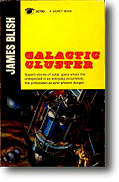
"There Shall be no Darkness" -Originally published in the April 1950 "Thrilling Wonder Stories". This is a flamboyant gothic tale of lycanthropy, for which Blish furnishes a remarkable pseudo-scientific explanation. Diabolically clever.The last four of these stories may also be found in the earlier GALACTIC CLUSTER (Signet,1959) collection. There is also some understandable duplication with the Faber BEST SCIENCE FICTION STORIES OF JAMES BLISH (1965). The Ballantine SO CLOSE TO HOME (1961) has only two stories reprinted in any of the other collections but is rather hard to find, as well as being somewhat conventional in content. ANYWHEN (Doubleday 1970) contains further interesting stories:
"Surface Tension" -Originally published in August 1952 "Galaxy". This celebrated tale would later furnish the centerpiece for his SEEDLING STARS "novel". An ingenious tale of conceptual breakthrough and biological engineering. Microscopic humans stranded on a freshwater pool on a alien planet fight to discover the nature of the Universe. Stapledonian vistas and pulp heroics.
"Common Time" -Originally published in the August 1953 "Science Fiction Quaterly". An intensely written story of inner and outer space travel. Much grist for the freudian mills.
"Beep" -Originally published in the February 1954 "Galaxy". An exuberant account of scientific and philosophical discovery, set in our far future galaxy. This story was later expanded, much to its detriment, into the novel QUINCUX OF TIME (Dell 1973).
"A Work of Art" -Originally published in the July 1956 "Science Fiction Stories". This account of the reanimation of Richard Strauss(!), is a meditation on the process and the nature of art.
"This Earth of Hours" -Originally published in the June 1959 "Fantasy and Science Fiction". A grim tale of first contact in which humanity meets its come-uppance. As remarkable for its portrait of the matriarchal galaxy-spanning human civilization as for its truly alien extra-terrestrials.

"Writing of the Rat" -Originally published in the July 1956 "Galaxy". Fascinating anthropo-cosmological speculation set in the frame of a cunning mystery.Novels
"And Some Were Savages" -Originally published in the november 1960 "Amazing". Planetary exploration, biological mysteries and alien cultures. Conventional in format but superior in execution.
"A Dusk of Idols" -first published in the March 1961 "Amazing". A marooned explorer discovers the true nature of a cruel alien civilization. A harrowing journey of (self) discovery with some powerful and arresting imagery.
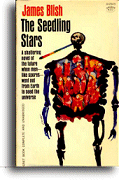
JACK OF EAGLES (Corwin, 1952). This is an expansion of "Let the Finder Beware" in the December 1949 "Thrilling Wonder Stories". Beyond the trite pulp plot and van vogtian superman theme of "psi powers" unleashed, there is a marvelous "hard science" attempt to rationalize ESP. Ingenious and amazing. No one has ever done it better.THE SEEDLING STARS (Gnome, 1957). In his Blish bibliography, Ketterer lists this as a novel but it is actually a collection of five stories turning around the theme of "Pantropy", the biological adaptation of humans to alien environments. There is only a thematic continuity, the protagonists and the locales being different in each story. They were originally published in "Galaxy" and "If" magazines. This is the most sustained of all Blish's efforts. The science, or rather the pseudo-science, is top rate.
THE FROZEN YEAR (Ballantine, 1957). This is hardly science fiction, indeed Blish called it a "contemporary novel", but it is an entertaining "mad scientist" yarn. Set during the international geophysical year, it recounts the slow unraveling of a polar expedition, as its Übermensch leader, obsessed by his quest for martian tektites, sinks into dementia and death. This odd book was published under the title FALLEN STAR in the U.K.
A CASE OF CONSCIENCE (Ballantine, 1958). This is probably his most celebrated work of fiction. The first part of the "novel" was originally published in "If" (september 1953), under the same title. It is an arresting mixture of scientific and theological speculation. The planet Lithia, lovingly described and detailed, is investigated by a Jesuit scientist who gradually comes to believe that the whole world is a diabolical snare for humanity. Unfortunately, the quality of the writing or of the imagination is not sustained throughout the expansion; which sees the scene of the action shift to a particularly unpleasant Earth.
DOCTOR MIRABILIS (Faber, 1964). No, this is not science fiction, but it is the authors' best novel, a scholarly historical novel on the life of Roger Bacon.
A TORRENT OF FACES (with Norman L. Knight) (Doubleday, 1967). This is a fix-up of three stories originally published in "Galaxy". A horribly overpopulated but politically stable future Earth is struck by a small asteroid. The sociological extrapolation is fascinating if somewhat unpleasant.
BLACK EASTER (or Faust Aleph-Null) (Doubleday, 1968). Expanded from a version originally serialized in "If" (August, September and October 1967). This is not science fiction either, but a tale of deviltry and ceremonial magic. Unscrupulous arms merchants practising the necromantic arts provoke a Nuclear War, the End of the World and the Reign of Satan. It isn't as much fun as it sounds. There is a pretty awful sequel THE DAY AFTER JUDGMENT (Doubleday, 1970).
CITIES IN FLIGHT (Avon,1970). This is actually a sequence of four "novels", previously published separately. In order of publication they are :
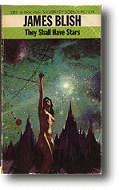
EARTHMAN COME HOME (Putnam's, 1955). An assemblage of four stories from "Astounding".David Pringle caracterizes them as "rather pretentious space operatic stories". Ketterer refers to them as "wagnerian spenglerian space opera". There is an attempt at grandeur, but it doesn't really overcome the basic sillyness. Despite some happy inventions at the beginning: "spindizzies", anti-gravity devices which permit entire cities to levitate into space and "anti-agathic drugs" which confer virtual immortality upon humanity, Blish himself seems to tire of the whole idea after the first few hundred pages of raher turgid copy. Not even the destruction of the Universe, (achieved at the end of the third volume) seems able to generate any kind of excitement. The superposition of an allegedly spenglerian framework on the sequence is more of an afterthought, and an unconvincing one at that, than anything else. Some people seem to enjoy it, but space opera has been better done by other hands, notably by Barrington Bayley.THEY SHALL HAVE STARS (Faber, 1956). A "fix-up" of two more "Astounding" novellas.
THE TRIUMPH OF TIME (Avon, 1958), known as A CLASH OF CYMBALS in the U.K.
A LIFE FOR THE STARS (Putnam's, 1961). This had previously been a serial the same year in "Analog".
For the sake of completion here is the list of the rest of Blish's novels, to the exclusion of the Star Trek work. Some of them are very minor indeed.
* THE WARRIORS OF DAY (1953)
* THE DUPLICATED MAN (with Robert Lowndes), (1953)
* VOR (1958)
* AND ALL THE STARS A STAGE (1960)
* THE STAR DWELLERS (1961)
* TITAN'S DAUGHTER (1961)
* THE NIGHT SHAPES (1962)
* MISSION TO THE HEART STARS (1965)
* WELCOME TO MARS (1968)
* THE VANISHED JET (1968)
* MIDSUMMER CENTURY (1972)As editor:
* NEBULA AWARD STORIES 5 (1970)
* NEW DREAMS THIS MORNING (1966)Nonfiction:
* THE TALE THAT WAGS THE GOD (Advent, 1987)
* THE ISSUE AT HAND (as William Atherling, Jr.) (Advent, 1964)
* MORE ISSUES AT HAND (as William Atherling, Jr.) (Advent, 1970)copyright 1998 Marc-André Brie
Back to James Blish: introduction Poetry of James Blish
Ascent of Wonder: James Blish
James Blish
Astounding Worlds of Barrington Bayley!
|Brian W. Aldiss|James Blish| Philip K. Dick|Charles L. Harness| A. E. van Vogt|
Introducing K. W. Jeter